

 DEUTSCH
 ENGLISH
Beach volleyball terms: the little lingo dictionary for the sand
Dig, shot, cut, side-out, husband and wife: words fly around at the net that might just make you nod and hope for the best. No stress: here are the most important beach volleyball terms, sorted by phase of play and explained in a relaxed way, so at camp you don't just play along – you can talk the talk too.
Key facts at a glance
- Over 30 beach volleyball terms, sorted by serve, defence, attack, block and rules.
- Most of these terms are used internationally – including at camp, where guests from different countries play together.
- You don't have to learn anything by heart: our coaches explain everything on court.
- Perfect as a cheat sheet before you hit the sand with us for the first time.
- Complements our camp vocabulary, which explains how the camp works.
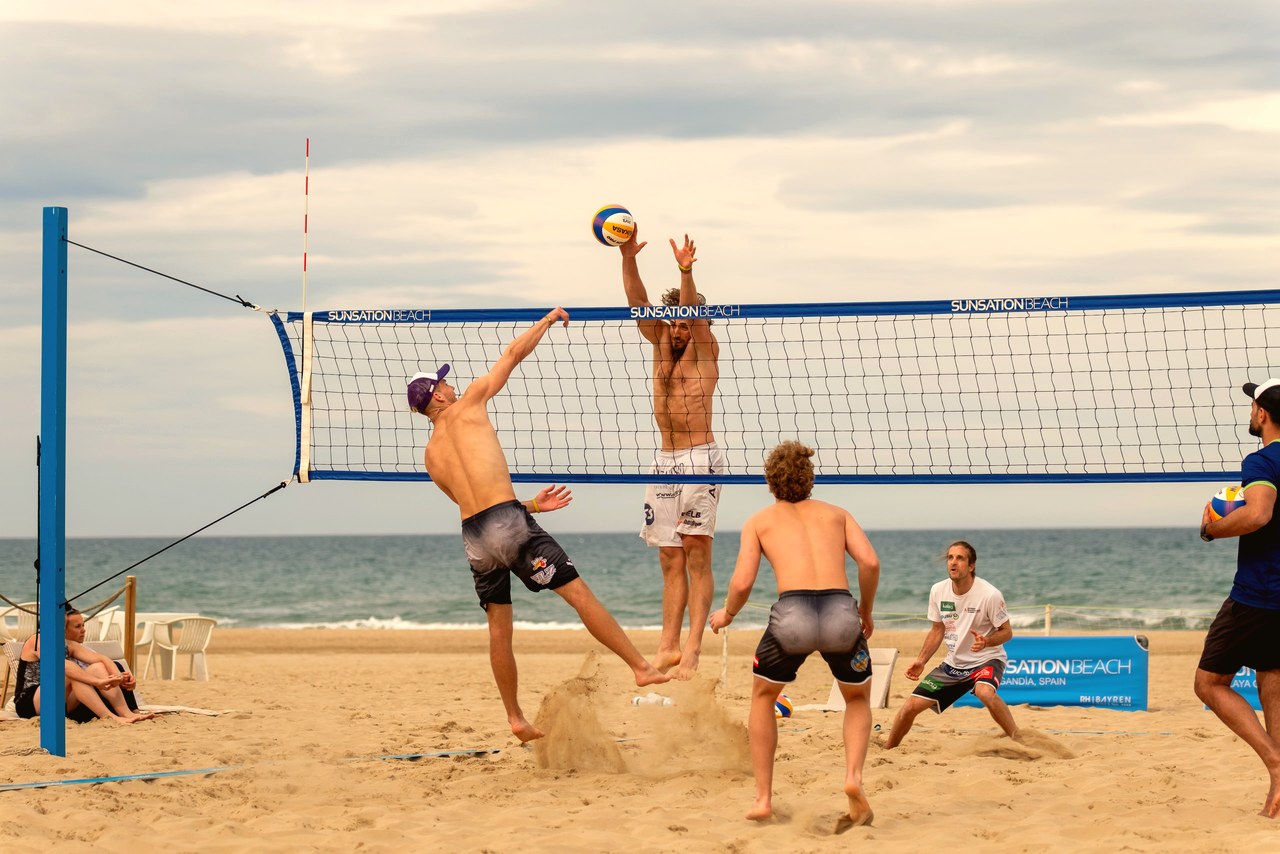
How do you serve in beach volleyball and what are the terms for it?
Every game starts with the serve, and there are more words for it than you might think. After this section you'll know the most important variations.
Float serve (floater)
A float serve is a serve without spin. Because air builds up behind the ball, it flutters and changes its flight path unpredictably. It's hard to read for the receiver.
Jump float
A jump float is a float serve that you hit with a small jump. It combines the fluttering flight path with a bit more speed.
Jump serve
For a jump serve you toss the ball high, jump and hit it like an attack, usually with topspin. It looks impressive and for most people at camp it's more of a spectator sport. Nobody expects it from you.
Sky ball (sun serve)
A sky ball is a very high serve, usually hit underhand. It makes use of wind or sun: whoever receives it looks into the sun and easily loses sight of the ball.
Ace
An ace is a serve that wins the point directly, because the opponent doesn't pass the ball cleanly or doesn't touch it at all. A serve that the opponent can only just control is also often called an ace in everyday language.
Which terms belong to reception, setting and defence?
After the serve, the work in defence begins. These are the words you'll hear most often at camp.
Bump (pass)
The bump is the forearm pass: you put your hands together and direct the ball with your forearms. It's the standard shot for reception and defence.
Set
A set brings the ball exactly where your partner expects it for the attack. It's played with both hands above your head, fingers spread. It's clean if the ball isn't held or carried.
Bump set
A bump set is a set with your forearms. You need it when there's no time for a hand set or you want to avoid a holding fault.
Dig
A dig is a defensive action where you save the ball before it touches the sand or flies out, usually after a hard attack. Typical: a long step, a dive, sand in your face. At camp, a good dig is celebrated like a point.
Beach dig
When a ball is hit very hard, you're allowed to briefly defend it in the sand with your hands above your head, as long as your fingers point upwards. That's called a beach dig.
Chicken wing
A chicken wing is a defensive action with just one arm. It doesn't look elegant, but it saves many a ball.
Shank
A shank is a failed pass where the ball sails off anywhere except to your partner. It happens to everyone, even the pros.
Husband and wife
Husband and wife is the nickname for a misunderstanding: both partners think the other is taking the ball, and it drops right between them into the sand. The fix: call loudly who's taking the ball.
How do you attack in beach volleyball and what are the shots called?
In the sand, brains often count more than power. That's why there are many types of attack that are all about placement.
Spike
A spike is a powerful attack where you hit the ball from a jump down into the opponent's sand. You'll also hear words like kill, slam or hammer for it. A kill is an attack that wins the point directly.
Shot
A shot is an attack where placement matters more than speed. You play the ball with closed fingers or the palm of your hand to a spot the opponent can hardly reach.
Cut shot (cut)
A cut shot is a soft, angled attack that sails just over the net, almost parallel to it, into the gap and lands close to the net.
Line shot
A line shot runs from the outside straight down the sideline on the opponent's side. If they're only expecting the cut, they're in the wrong spot.
Poke (pokey)
A poke or pokey is an attacking ball you play with your middle knuckles. It usually comes softly over the block.
Dink
A dink is a ball played gently just over the net or the blocker's hands. It's allowed as long as you don't open your fingers.
Loopy (roll shot)
A loopy is a slow, high-arcing attack over the block, deep into the corner or across the court. It's also called a roll shot.
Rainbow shot
A rainbow shot flies in a high arc over the defender far towards the back.
Shoot
A shoot is a set played directly into a free spot on the opponent's side to win the point. How such a two-handed set may be played is precisely regulated – if in doubt, ask your coach.
Tool (using the block)
You talk about a tool when the ball bounces off the opponent's block and goes out. The point goes to the attacker.
Which terms are there for blocking?
At the net, timing and courage count. You'll hear these terms when it comes to the first line of defence.
Block
When blocking, you jump close to the net with arms stretched high over the top of the net to stop the opponent's attack.
Stuff block (roof)
A stuff block or roof is a block that pushes the ball straight back into the attacker's sand. That's the point everyone at the net loves most.
Joust
A joust is when two opponents touch and hold the ball above the net at the same time, each with open fingers.
Sizzle the pits
When a flat, hard attack slips through under the blocker's arms, it's called "sizzle the pits". Annoying for the blocker, a reason to grin for the attacker.
How does the game work and what faults are there?
You'll also hear a few words about points and rules again and again at camp.
Side-out
A side-out means you win the rally while receiving your opponent's serve, and so you get the right to serve. So if someone says after the set that you sided out well, they've just praised you.
Rally point
Since 2001, every rally counts as a point, no matter who served. This scoring system is called rally point.
Lift and throw
A lift or throw is a fault where the ball comes to rest in your hands instead of being played cleanly.
Foot fault
A foot fault is a fault on the serve, for example when your foot is on the line or in the court before you hit the ball.
Screening
Screening means blocking the opponent's view of the server during the serve. That's not allowed.
Switching sides
In beach volleyball, teams switch sides after every seven points, and after every five in the third set. A set goes to 21 points, the third to 15.
Frequently asked questions
Do I need to know the beach volleyball terms before camp?
No. You don't have to learn anything by heart. Our coaches explain everything on court, and after a few days in the sand the terms stick by themselves.
Why are these terms used internationally?
Many technical terms in beach volleyball come from English and are used worldwide. That also helps at camp, where guests from different countries play together.
What's the difference between a shot and a cut?
A shot is any placed attack where feel matters more than power. A cut is a specific type of it: soft, angled and just over the net.
What's the difference between a dig and a bump?
The bump is the forearm shot; the dig is the situation: you save a ball before it hits the ground, usually after a hard attack, often with a bump.
What does side-out mean?
A side-out means that the receiving team wins the rally and thereby gets the right to serve.
Are there other terms I should know for everyday camp life?
Yes, for example social scramble, player questionnaire and travel companion. We explain those in our article on the little camp vocabulary.
Curious? Then come along and speak the language of the sand live. You'll find all camps and dates on volleytours.com/en/camps-events – come as a player, leave as a friend.