

 DEUTSCH
 ENGLISH
Beach volleyball rules quiz: how well do you know the rules?
Two against two, one net, loads of sand: the basic idea is quickly explained, but even experienced players stumble over the rules. This beach volleyball rules quiz has ten questions, with the answer right below each one.
Write down your answers and compare at the end: how many did you get right? The rules are based on the official FIVB rules – but at our net, fun counts most. (As of: October 2026)
Key facts at a glance
- Ten questions on number of players, scoring, switching sides, touches, block, serve and timeouts.
- Answers according to the official FIVB rules, with each answer right below the question.
- At the end there's a little evaluation of how rule-savvy you are.
- At camp you pick up the rules along the way, without exam stress.
Question 1: How many players does a team have, and can you substitute?
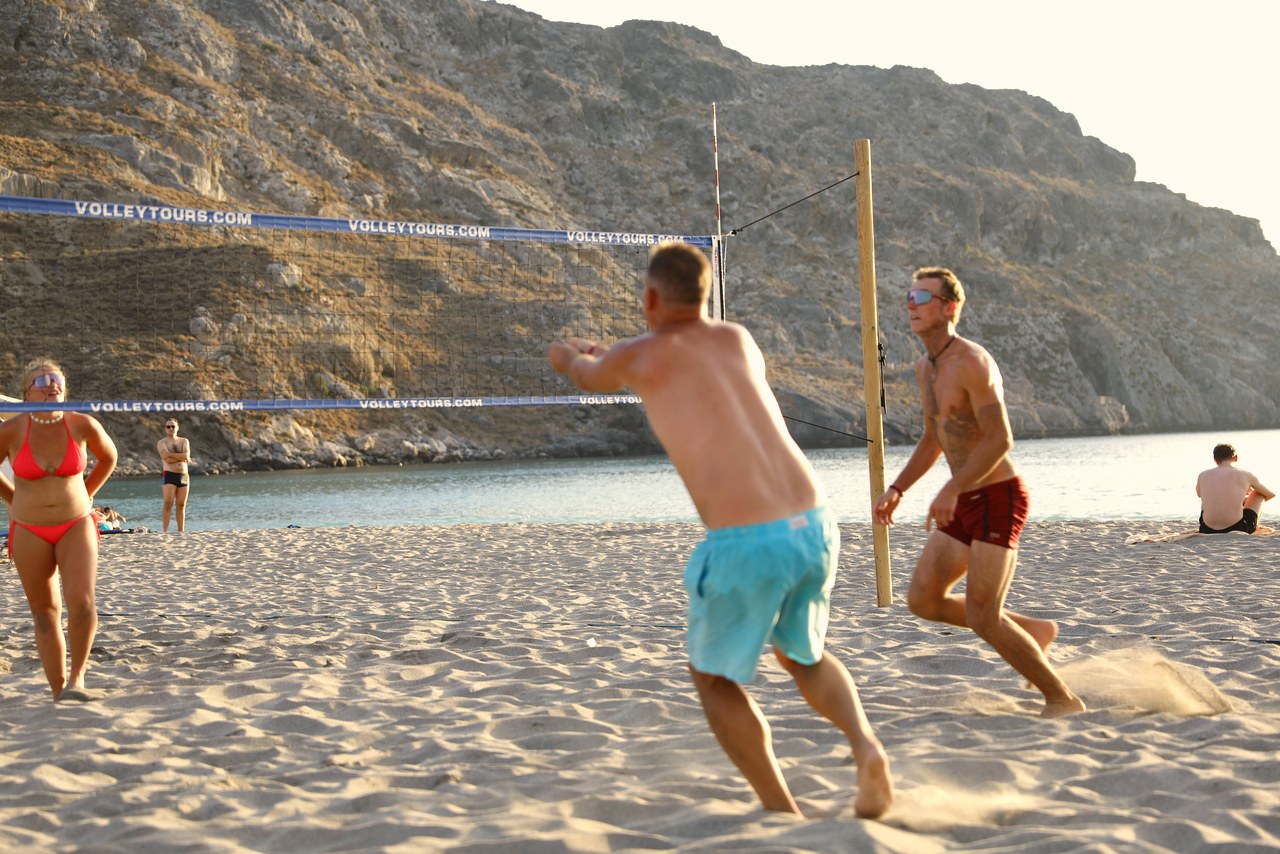
- A) Two players, substitutions are allowed
- B) Two players, no substitutions
- C) Three players, substitutions allowed
Answer: B. A team consists of two players, and both must always be in the game. There are no substitutions, so both partners have to last the whole match.
Question 2: How many points does a set go to?
- A) 15 points
- B) 21 points with a lead of at least two points
- C) 25 points
Answer: B. The first two sets go to 21 points, and a team needs a lead of at least two points. So at 20:20 play continues until one team leads by two, for example 22:20 or 23:21.
Question 3: How long is the deciding set?
- A) To 11 points
- B) To 15 points with a two-point lead
- C) To 21 points
Answer: B. If it's 1:1 after two sets, a third set to 15 points decides, again with a lead of at least two points. Whoever wins two sets wins the match.
Question 4: When do teams switch sides?
- A) Only between sets
- B) After every 7 points, in the third set after every 5
- C) After every 10 points
Answer: B. In sets one and two, teams switch sides after every 7 points played, in the third set after every 5. That balances out sun and wind, and no team is stuck on the worse side for good.
Question 5: How many times can a team touch the ball?
- A) Twice
- B) Three times
- C) As often as they like
Answer: B. Each team may touch the ball up to three times before it has to go over the net. Unintentional touches count too. But the same player may not play the ball twice in a row, except after a block.
Question 6: How does a block count?
- A) Not at all – the block doesn't count as a touch
- B) As the first of the three touches
- C) As an extra fourth touch
Answer: B. In the sand, a block counts as one of the three touches. After that the team has two left, and then any player may play the ball, including the blocker. Indoors it's different: there the block doesn't count.
Question 7: Which body part can you play the ball with?
- A) Only hands and arms
- B) Any body part, but the ball must not be caught or thrown
- C) Only hands, arms and head
Answer: B. The ball may be played with any part of the body. But it must be hit cleanly – catching, holding or throwing is not allowed.
Question 8: Who serves after a rally is won?
- A) Always the partner
- B) The player who served last, if the serving team wins the point
- C) The player who scored the point
Answer: B. If the serving team wins the rally, the same player serves again. If the receiving team wins, it gets the serve, and then the player who didn't serve last time serves.
Question 9: How many timeouts are there?
- A) None
- B) One 30-second timeout per team per set, plus a technical timeout at 21 total points
- C) Two two-minute timeouts
Answer: B. Each team has one 30-second timeout per set. In sets one and two, a 30-second technical timeout is added automatically as soon as both teams' points add up to 21.
Question 10: Can you cross under the net to the other side?
- A) No, that's always a fault
- B) Yes, as long as you don't interfere with the opponent
- C) Only in the deciding set
Answer: B. In the sand, a player may cross the centre line under the net or outside the posts, as long as this doesn't interfere with the opponent. Indoors that would be a fault.
How did you do? The evaluation
- 0 to 4 correct: Perfect – there's lots left to learn at camp. That's what we're here for.
- 5 to 8 correct: Solid knowledge. After a few games in the sand, the details will stick quickly.
- 9 to 10 correct: Rules pro. We're already looking forward to you explaining the timeout to us at the tournament.
What matters is that you have fun. With us you learn the rules at the net, not in a classroom, and nobody gets tested.
Frequently asked questions
How big is a beach volleyball court?
The court measures 16 by 8 metres, and according to the FIVB the sand must be at least 40 centimetres deep. That's smaller than indoors, where the court measures 18 by 9 metres.
How high is the net?
The net is 2.43 metres high for men and 2.24 metres for women.
Why do teams switch sides?
To balance out external conditions like sun and wind. Teams switch after every 7 points in the first two sets, and after every 5 in the third set.
Do these rules apply at camp too?
The rules come from the official rulebook. At camp, fun comes first, and you learn the rules along the way while playing.
Conclusion
Rules aren't an end in themselves – they make the game fair and fast. If this quiz has made you want to try them out in the sand, you're in the right place with us.
Curious? You'll find all camps and dates on volleytours.com/en/camps-events. See you at the net: come as a player, leave as a friend.